If your child is struggling to express themselves, pronouncing words differently, or not talking as much as other children their age, you’re not alone. Many parents in Islamabad notice these signs and wonder whether their child needs help. Speech therapy for children in Islamabad has become increasingly accessible, and understanding when and how to seek support can make all the difference in your child’s development.
Every child develops at their own pace, but sometimes they need a little extra help to find their voice. Whether your child is dealing with speech delay, stuttering, or communication challenges related to autism spectrum disorder, professional speech therapy can open doors to better communication, confidence, and connection with the world around them.
What is Speech Therapy for Children?
Speech therapy is a specialized form of treatment that helps children improve their communication skills. A child speech therapist, also called a speech-language pathologist, works with children who have difficulties with speech sounds, language comprehension, voice quality, or fluency. The therapy addresses various communication disorders that can affect how children express themselves and understand others.
Speech and language therapy in Islamabad focuses on several key areas. These include articulation problems where children struggle to produce certain sounds correctly, expressive language disorder where they have trouble putting words together to form sentences, and receptive language disorder where understanding what others say becomes challenging. The therapy also helps with fluency disorders like stuttering, voice disorders, and even feeding and swallowing difficulties.
At centers like Special School of Recovery (SSR), pediatric speech therapy uses play-based activities, structured exercises, and interactive techniques that make learning enjoyable for children. The goal isn’t just to fix a problem but to help your child develop confidence in their ability to communicate effectively.
Why Speech Therapy is Important for Children’s Development
Communication is the foundation of learning, social interaction, and emotional expression. When children struggle with speech or language, it can affect their ability to make friends, perform well in school, and express their needs and feelings. Early speech therapy intervention can prevent these challenges from becoming bigger obstacles as your child grows.
Research shows that children who receive speech therapy early often catch up to their peers more quickly. The brain’s plasticity during early childhood means that young children respond particularly well to therapy. This is why speech therapy for toddlers and preschoolers can be so effective.
Language development milestones provide a roadmap for what children should typically achieve at different ages. By age two, most children can use two-word phrases. By three, they speak in simple sentences. By four, they tell stories and engage in conversations. When children fall significantly behind these milestones, speech delay treatment becomes important to help them develop the communication skills they need for school readiness and social skills development.
Beyond academics, communication skills affect a child’s emotional wellbeing. Children who can’t express themselves may become frustrated, withdrawn, or exhibit behavioral challenges. Speech therapy helps children find their voice, literally and figuratively, which can boost confidence and improve their overall quality of life.
Signs Your Child May Need Speech Therapy
As a parent, you know your child best. If something doesn’t feel right about how your child communicates, trust your instincts. Here are some signs that suggest your child might benefit from professional evaluation:
For Toddlers (1-3 years):
- Not using any words by 18 months
- Using fewer than 50 words by age 2
- Not combining two words by age 2
- Difficulty imitating sounds or words
- Limited eye contact during communication
For Preschoolers (3-5 years):
- Speech is difficult for family members to understand
- Leaving out sounds in words regularly
- Substituting easy sounds for difficult ones past age 3
- Struggling to follow simple instructions
- Limited vocabulary compared to peers
- Not asking questions or engaging in conversation
For School-Age Children:
- Stuttering that persists or worsens
- Trouble with reading and writing
- Difficulty organizing thoughts when speaking
- Voice that sounds consistently hoarse or nasal
- Avoiding speaking situations
- Being teased about their speech
Some children may also show signs related to specific conditions. Autism speech therapy addresses unique communication challenges for children on the spectrum, including difficulty with social communication, understanding non-verbal cues, and using speech in context. Children with hearing impairment, cleft palate, Down syndrome, or cerebral palsy often need specialized speech pathology services tailored to their specific needs.
If you notice any of these signs, seeking a speech assessment can provide clarity. At qualified centers in Islamabad, speech screening is often the first step to understanding your child’s needs.
How Speech Therapy Helps Child Development
Speech therapy works through a structured, individualized approach. When you first visit a speech therapy center, your child will undergo a comprehensive evaluation. This speech therapy assessment process examines your child’s articulation, language comprehension, vocabulary, sentence formation, and overall communication abilities.
Based on this assessment, the speech therapist creates an individualized therapy plan with specific, measurable goals. These might include improving pronunciation of specific sounds, expanding vocabulary, building sentence structure, or improving social communication skills.
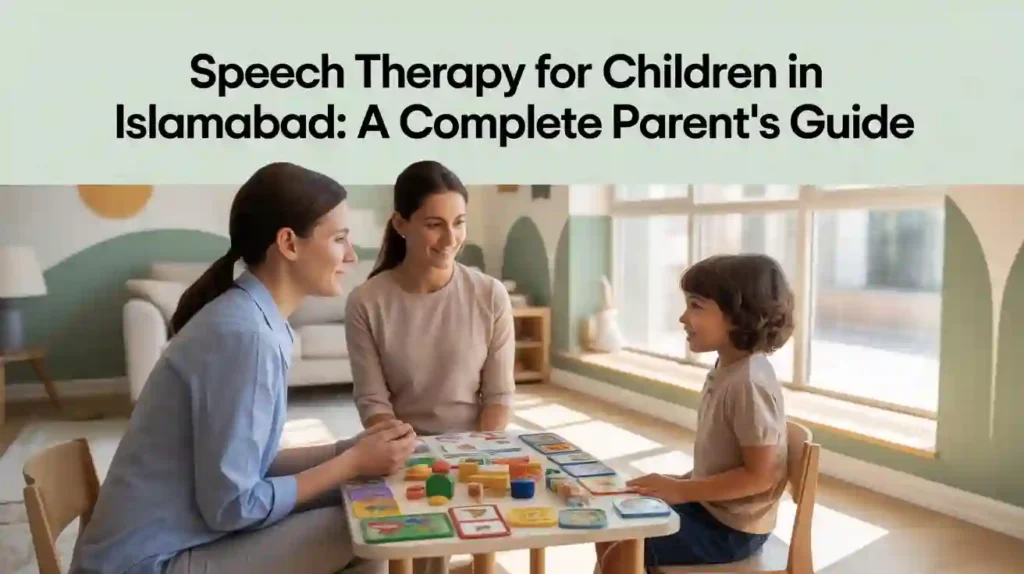
What happens during a speech therapy session? Sessions typically last 30 to 45 minutes and are filled with activities that feel like play to children. A therapist might use picture cards to work on vocabulary expansion, play interactive games to practice sentence formation, or use mirrors to help children see how to position their tongue and lips for certain sounds.
For younger children, therapy often incorporates songs, stories, and toys that keep them engaged while targeting specific goals. For older children, therapists might use conversation practice, reading activities, or technology-based tools that make learning interactive.
Speech therapy also addresses oral motor skills through exercises that strengthen the muscles used for speaking and swallowing. This is particularly important for children with feeding therapy needs or those who have difficulty with certain sound productions due to muscle coordination issues.
The therapy isn’t just about what happens in the clinic. Parent training in speech therapy is crucial for success. Therapists teach parents specific techniques and exercises to practice at home, turning everyday moments into learning opportunities.
The Crucial Role of Parents in Therapy Success
Your involvement as a parent can dramatically accelerate your child’s progress. Speech therapists often say that the most successful outcomes happen when parents become co-therapists at home. This doesn’t mean you need to become an expert, but rather that you incorporate simple practices into daily life.
Here’s how you can support your child’s speech development at home:
Talk frequently throughout the day, narrating what you’re doing and asking open-ended questions. Instead of yes/no questions, ask “What do you think will happen next?” or “How did that make you feel?” This encourages your child to use more language.
Read together every day. Books provide rich vocabulary and natural opportunities to discuss sounds, words, and stories. Point to pictures, ask prediction questions, and have your child retell stories in their own words.
Practice speech therapy exercises your therapist assigns, but make them fun rather than work. Incorporate them into games, bath time, or car rides. Consistency matters more than perfection.
Model correct speech without criticism. If your child says “wabbit” instead of “rabbit,” simply respond with “Yes, that’s a rabbit!” This gives them a correct model without making them feel wrong.
Celebrate small victories. Communication development happens gradually, and acknowledging progress keeps your child motivated and confident.
Be patient and give your child time to respond. Resist the urge to finish their sentences or speak for them. This patience shows respect for their efforts and encourages them to keep trying.
Create a language-rich environment at home. Label objects around the house, sing songs, play rhyming games, and limit screen time in favor of interactive conversation. These simple activities support what happens in therapy sessions.
Why Early Intervention Makes All the Difference
The research is clear: early intervention therapy leads to better outcomes. Children’s brains are remarkably adaptable during the early years, making this the optimal window for addressing speech and language challenges. What might require intensive therapy later can often be resolved more easily when caught early.
Early intervention doesn’t just improve speech. It supports overall development. Children with strong communication skills tend to have better academic success, more positive peer relationships, and fewer behavioral challenges. They’re better able to advocate for themselves and navigate social situations.
In Pakistan, awareness about early childhood development has grown significantly in recent years. More parents are recognizing developmental delays earlier and seeking help promptly. Organizations like the Pakistan Council for Rehabilitation of Disabled Persons (PCRPD) have worked to increase access to therapy services across the country.
Many parents worry about whether their concerns are valid or whether they should “wait and see.” While some children are indeed late bloomers, the risk of waiting is that valuable time passes. A professional speech evaluation can give you peace of mind if everything is fine, or it can start your child on a path to improvement if help is needed.
The good news is that speech therapy is highly effective. Studies show that most children make significant progress when they receive appropriate, consistent therapy. Many children with speech delays or disorders eventually communicate at age-appropriate levels or better.
Why Choose Special School of Recovery (SSR)
When looking for the best speech therapist for children in Islamabad, parents need a center that combines expertise, compassion, and proven results. Special School of Recovery (SSR) has established itself as a leading therapy center for special children in Islamabad, offering comprehensive, evidence-based therapy services.
Located in the heart of Islamabad, SSR provides a nurturing environment where children feel safe and excited to learn. The center employs certified speech-language pathologists who hold recognized credentials and stay current with the latest therapy techniques.
What sets SSR apart:
SSR takes a multidisciplinary therapy approach, meaning your child benefits from coordinated care among speech therapists, occupational therapists, behavior therapists, and special educators when needed. This holistic approach addresses all aspects of development rather than focusing narrowly on one area.
The center creates individualized therapy plans tailored to each child’s unique needs, strengths, and challenges. There’s no one-size-fits-all approach here. Your child’s therapy program evolves as they progress, with regular therapy progress monitoring to ensure goals are being met.
Parent involvement is central to SSR’s philosophy. The team provides extensive parent counseling for special needs children and trains parents to continue therapy activities at home. You’re not just dropping your child off for therapy; you’re becoming part of the solution.
SSR offers flexible therapy options including individual sessions, group therapy for children who can benefit from peer interaction, and guidance for home-based practice. The center also provides bilingual speech therapy for children navigating both Urdu and English, recognizing Pakistan’s unique linguistic landscape.
The facilities are child-friendly, equipped with modern therapy tools and resources that make sessions engaging and effective. From sensory integration therapy rooms to spaces designed for play-based learning, every aspect of the center supports child development.
For families seeking autism therapy centers in Islamabad, SSR provides specialized programs for children on the autism spectrum, addressing their unique communication needs with evidence-based approaches like visual supports, social stories, and structured teaching methods.
Explore our speech, behaviour and occupational therapy services to learn how we can support your child’s journey to better communication.
Real Success Stories from Islamabad Families
Ayesha brought her three-year-old son Ahmed to SSR after noticing he wasn’t talking as much as his cousins. Ahmed used only a handful of words and became frustrated when family members didn’t understand him. After six months of consistent speech therapy, Ahmed’s vocabulary exploded. He started forming sentences, singing songs, and even telling jokes. “I never thought I’d hear my son have a full conversation,” Ayesha shares. “Speech therapy gave him his voice.”
Five-year-old Sara had a severe stutter that made her reluctant to speak at school. Her parents worried about her confidence and social development. Through fluency therapy and parent training, Sara learned techniques to manage her stuttering. While she still has occasional difficulties, she now participates enthusiastically in class and has made close friendships. Her parents credit the patient, encouraging approach of her therapist for this transformation.
Bilal, a seven-year-old with autism spectrum disorder, struggled with both speech and social communication. He rarely made eye contact and used mostly single words to communicate. After a year of specialized autism speech therapy combined with social skills training, Bilal now initiates conversations, makes requests clearly, and has begun reading. His progress shows how effective tailored intervention can be for children with complex needs.
These stories aren’t exceptional—they represent what’s possible when children receive quality speech therapy and families commit to the process.
Key Benefits of Speech Therapy for Your Child
The advantages of professional speech therapy extend far beyond clearer pronunciation:
- Improved communication abilities that allow children to express their needs, thoughts, and feelings effectively
- Enhanced academic performance as language skills directly support reading, writing, and classroom participation
- Better social relationships since communication is essential for making friends and navigating social situations
- Increased confidence and self-esteem as children gain competence in expressing themselves
- Reduced frustration and behavioral issues that often stem from communication difficulties
- Development of critical thinking skills through language-based activities that challenge cognitive abilities
- Better family relationships as communication improves between children and parents
- Preparation for school success through development of vocabulary, listening skills, and conversation abilities
- Skills for lifelong learning since strong communication supports all future educational endeavors
Speech therapy isn’t just about fixing a problem—it’s about equipping your child with essential life skills that will serve them forever.
Understanding Therapy Timeline and Expectations
One of the most common questions parents ask is: how long does speech therapy take to show results? The answer depends on several factors including the nature and severity of the speech or language disorder, your child’s age, consistency of therapy attendance, and practice at home.
Some children show improvement within weeks, particularly if they have mild articulation issues. Others with more complex conditions may need therapy for several months or even years. Most children attend therapy one to three times per week, with sessions lasting 30 to 45 minutes.
The speech therapy process follows a general pattern. Initial assessment and goal setting typically happen in the first few sessions. Early intervention focuses on building rapport and establishing basic skills. The middle phase involves intensive work on specific goals with regular progress checks. The final phase includes generalization of skills to different settings and gradually reducing therapy frequency as independence grows.
It’s important to maintain realistic expectations while staying hopeful. Progress isn’t always linear—your child may have periods of rapid improvement followed by plateaus. This is normal. Consistent therapy, home practice, and patience usually lead to positive outcomes.
Frequently Asked Questions About Speech Therapy
When should a child start speech therapy?
Children can begin speech therapy as young as 18 months if significant delays are present. However, the best time to start is as soon as you notice concerns about your child’s communication development. Early intervention during the preschool years (ages 2-5) tends to be most effective, but older children and even teenagers can still benefit significantly from speech therapy.
How much does speech therapy cost in Islamabad?
Speech therapy costs in Islamabad vary depending on the center, therapist qualifications, and session length. Private therapy typically ranges from PKR 1,500 to PKR 4,000 per session. Some centers offer package deals that reduce per-session costs. SSR provides transparent pricing and works with families to make therapy accessible. It’s worth noting that investing in therapy early often reduces the total cost and time needed for treatment.
Can speech therapy be done at home?
While professional assessment and guidance are essential, much of speech therapy can be reinforced at home. Therapists provide parents with specific exercises and activities to practice between sessions. Some centers also offer home-based speech therapy services where therapists visit your home. Additionally, online speech therapy for kids in Islamabad has become more available, offering flexibility for families with scheduling challenges.
What qualifications should a speech therapist have?
Look for licensed speech therapists with proper credentials from recognized institutions. In Pakistan, qualified speech-language pathologists typically hold degrees in speech therapy, audiology, or related fields from Higher Education Commission-approved universities. Many also pursue international certifications or training. Don’t hesitate to ask about a therapist’s qualifications, experience with your child’s specific condition, and their approach to treatment.
How do I know if my child is making progress?
Your therapist should provide regular progress updates based on the initial therapy goals. You’ll likely notice improvements in your child’s daily communication—using new words, speaking more clearly, initiating conversations, or showing less frustration. Keep notes about changes you observe at home and share them with your therapist. Progress monitoring is an ongoing collaboration between therapist and family.
Is speech therapy covered by insurance in Pakistan?
Some health insurance policies in Pakistan include coverage for therapy services, but coverage varies widely. Check with your insurance provider about speech therapy benefits, coverage limits, and whether pre-authorization is required. Some companies offer reimbursement for medically necessary therapy. Even without insurance, many families find that the investment in their child’s development is worthwhile.
Choosing the Right Speech Therapy Center in Islamabad
Islamabad offers several options for pediatric speech therapy, from government facilities to private centers. When evaluating where to take your child, consider these factors:
Location and accessibility: Choose a center that’s convenient for regular visits. Centers in areas like F-6, F-7, F-8, Blue Area, Bahria Town, and DHA Islamabad offer various options. Regular attendance is crucial for progress, so proximity matters.
Therapist qualifications and experience: Ask about the educational background and experience of therapists, particularly with your child’s specific challenges. Experienced therapists can adapt approaches based on what works for each individual child.
Approach and philosophy: Some centers emphasize play-based therapy, while others use more structured approaches. Visit the facility, observe a session if possible, and see if the environment feels right for your child.
Parent involvement: Look for centers that welcome and encourage parent participation. The best outcomes happen when parents are active partners in the therapy process.
Range of services: If your child has needs beyond speech therapy, a center offering occupational therapy, behavior therapy, and special education services under one roof can provide more coordinated care.
Success stories and references: Ask about outcomes for children similar to yours. Reputable centers should be able to share testimonials or connect you with other families.
Affordability and flexibility: Understand the cost structure, whether packages are available, and if the center offers flexible scheduling including weekend or evening appointments.
According to recommendations from the American Speech-Language-Hearing Association (ASHA), quality therapy centers maintain high professional standards, use evidence-based practices, and prioritize individualized treatment plans.
Moving Forward: Taking the First Step
If you’ve been wondering whether your child needs speech therapy, or if you’ve been putting off making that first appointment, consider this your encouragement to take action. Every day of delay is a missed opportunity for your child to develop skills that will benefit them for life.
The first step is simple: schedule an assessment. During this initial evaluation, a speech therapist will spend time with your child, conduct age-appropriate tests, and help you understand whether therapy is recommended. Even if therapy isn’t needed, you’ll have peace of mind and helpful information about supporting your child’s development.
Remember that seeking help for your child isn’t admitting failure as a parent—it’s demonstrating love and commitment to their wellbeing. Children don’t “outgrow” significant speech delays without help, and waiting rarely improves outcomes.
Speech therapy has helped countless children in Islamabad find their voices, build confidence, and achieve their full potential. Your child deserves that same opportunity. The journey might seem daunting, but with the right support, dedication, and professional guidance, your child can develop the communication skills they need to thrive.
Whether your three-year-old isn’t talking yet, your five-year-old stutters, or your school-age child struggles with pronunciation, professional speech therapy can help. The compassionate, skilled team at centers like SSR understands what you’re going through and is ready to support both you and your child every step of the way.
Your Child’s Voice Matters
Every child has something valuable to say. When speech or language difficulties get in the way, therapy can remove those barriers and help your child express the unique person they are. From improving articulation to building vocabulary, from managing stuttering to developing social communication skills, speech therapy opens doors.
Don’t let another month pass wondering if your child might benefit from help. The specialized team at Special School of Recovery understands the unique challenges faced by Pakistani families and provides culturally sensitive, professionally excellent care that makes a real difference.
Book an assessment today at Special School of Recovery (SSR), Islamabad and give your child the support they deserve. Visit our wesbite or contact us to schedule your child’s evaluation. Together, we can help your child develop the communication skills that will serve them throughout their life.
Your child’s journey to confident communication starts with a single step. Take it today.
Special School of Recovery (SSR) is Islamabad’s trusted center for speech therapy, occupational therapy, behavior therapy, and special education services. Our evidence-based, family-centered approach has helped hundreds of children reach their developmental milestones and achieve success in school and life.