When your child struggles with communication, the terms “speech delay” and “language disorder” often come up during conversations with doctors and therapists. But what’s the real difference? And more importantly, how does understanding this distinction help you get the right support for your child?
Many parents in Pakistan find themselves confused by these terms, worrying whether their child’s communication challenges are temporary or require long-term intervention. The good news is that with proper understanding and early intervention therapy, most children can make significant progress in their communication abilities.
Let’s break down these concepts in simple terms so you can better advocate for your child’s needs.
What is Speech? What is Language?
Before we dive into delays and disorders, it’s essential to understand that speech and language are two distinct but interconnected aspects of communication.
Speech is the physical act of making sounds. It involves:
- Articulation (forming sounds correctly)
- Voice quality (how your voice sounds)
- Fluency (the flow and rhythm of speech)
Think of speech as the mechanics of talking—the physical movements of your lips, tongue, jaw, and vocal cords that produce sounds.
Language, on the other hand, is about understanding and using words to communicate ideas. It encompasses:
- Vocabulary (the words we know)
- Grammar (how we put words together)
- Social communication (using language appropriately in different situations)
Language is the content and meaning behind communication, while speech is the vehicle that delivers it.
Speech Delay: A Temporary Setback
A speech delay occurs when a child develops speech skills more slowly than expected but follows the typical developmental pattern. These children are on the right path—they’re just moving at their own pace.
Common Signs of Speech Delay
Children with speech delays typically show these characteristics:
- They understand language well for their age
- They follow the normal sequence of speech development, just slower
- Their speech errors are age-appropriate, just lingering longer than usual
- They communicate effectively using gestures, expressions, and limited words
- They show interest in communicating and connecting with others
For example, a child with a speech delay might not be using two-word combinations at age 2, but by age 3, they catch up and start forming sentences. Their progression follows the expected pattern—it’s simply delayed.
Causes of Speech Delays
Several factors can contribute to speech delays:
- Oral motor difficulties affecting tongue and lip coordination
- Hearing problems that went undetected
- Limited exposure to language and conversation
- Premature birth or low birth weight
- Family history of late talking
- Tongue-tie or other physical issues
Many children who are late talkers eventually catch up without intensive intervention, especially when parents actively support language development at home.
Language Disorder: A More Complex Challenge
A language disorder is different. It’s a diagnosed condition where a child has significant difficulty understanding or using language in ways that don’t match typical developmental patterns. This isn’t about being “a little behind”—it’s about how the brain processes and uses language.
Types of Language Disorders
Expressive Language Disorder Children with this condition struggle to communicate their thoughts, needs, and feelings. They might:
- Have a very limited vocabulary for their age
- Use short, simple sentences when peers use complex ones
- Struggle to find the right words
- Make grammatical errors that persist
- Have trouble telling stories or explaining events
Receptive Language Disorder These children have difficulty understanding what others say. Warning signs include:
- Not following simple instructions
- Seeming confused during conversations
- Giving unrelated answers to questions
- Difficulty understanding concepts like colors, numbers, or positions
- Trouble grasping jokes or figurative language
Mixed Receptive-Expressive Language Disorder Some children struggle with both understanding and using language, which presents the most significant challenges to daily communication and learning.
Causes of Language Disorders
Language disorders often have neurological roots:
- Developmental language disorder (previously called specific language impairment)
- Autism spectrum disorder
- Intellectual disabilities
- Brain injury or neurological conditions
- Genetic factors affecting language processing
Unlike speech delays, language disorders typically require specialized therapeutic interventions and don’t simply resolve with time.
Key Differences: Speech Delay vs Language Disorder
Understanding the distinction helps you know what to expect and what kind of help your child needs.
| Aspect | Speech Delay | Language Disorder |
|---|---|---|
| Understanding | Age-appropriate comprehension | May struggle to understand language |
| Development Pattern | Follows typical sequence, just slower | Atypical patterns or gaps in development |
| Prognosis | Often catches up by school age | Usually requires ongoing intervention |
| Communication Skills | Good use of gestures and non-verbal communication | May have broader communication difficulties |
| Speech Quality | Pronunciation issues | May have clear speech but limited content |
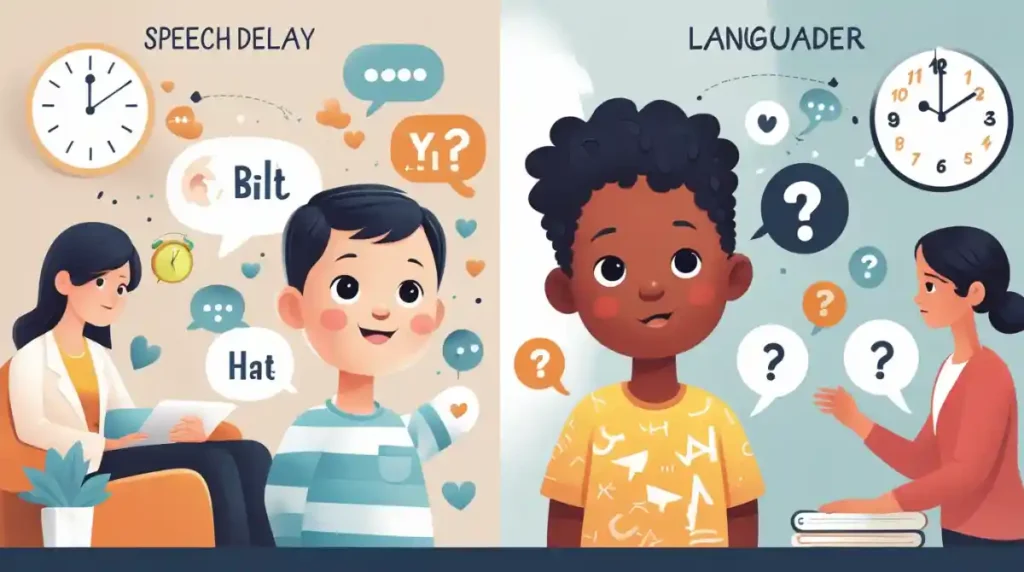
Here’s a practical example: Imagine two 3-year-olds.
Child A (speech delay) can point to what they want, follows instructions perfectly, and tries to say words but they come out unclear. They say “tat” for “cat” and “bu” for “bus.” They understand everything you say.
Child B (language disorder) might pronounce words clearly but only uses 10-15 words total. They don’t combine words, struggle to follow two-step directions, and seem confused when you ask them questions, even simple ones.
Child A has a speech issue—the mechanics of talking. Child B has a language issue—the understanding and use of words and concepts.
When Should You Be Concerned?
Every child develops at their own pace, but certain red flags warrant professional evaluation:
By Age 2:
- Fewer than 50 words
- Not combining two words together
- No attempts to imitate words or sounds
- Doesn’t respond to their name consistently
By Age 3:
- Speech is mostly unintelligible to strangers
- Not using simple sentences
- Difficulty following simple commands
- Limited interest in interacting with others
By Age 4-5:
- Still making significant pronunciation errors
- Trouble answering basic questions
- Can’t tell a simple story
- Difficulty with concepts like colors, sizes, or numbers
According to the <a href=”https://www.who.int/” target=”_blank” rel=”noopener”>World Health Organization</a>, early identification of developmental delays significantly improves outcomes through timely intervention.
The Evaluation Process: What to Expect
When you seek help for communication concerns, a qualified speech-language pathologist will conduct a comprehensive evaluation.
Assessment Components
- Case History: The therapist will ask about pregnancy, birth, developmental milestones, medical history, and your specific concerns.
- Standardized Testing: Your child will complete age-appropriate tests measuring:
- Receptive language skills
- Expressive language abilities
- Articulation and phonology
- Pragmatic language (social communication)
- Play-Based Observation: For younger children, therapists assess communication during natural play situations.
- Oral Motor Examination: Checking how the mouth, tongue, and lips move for speech.
- Hearing Screening: Ensuring hearing isn’t affecting speech and language development.
At <a href=”https://ssr.org.pk/”>Special School of Recovery (SSR)</a>, our experienced team conducts thorough assessments to determine whether your child has a speech delay, language disorder, or both, creating a clear path forward.
Treatment Approaches: Tailored to Your Child’s Needs
The treatment for speech delays versus language disorders differs significantly.
Speech Delay Treatment
For children with speech delays, therapy focuses on:
- Articulation practice: Learning to produce specific sounds correctly
- Oral motor exercises: Strengthening muscles used for speech
- Phonological awareness: Understanding sound patterns
- Parent coaching: Teaching families to support speech development at home
Many children with simple speech delays show rapid improvement with consistent practice. The speech therapy for toddlers Islamabad often involves play-based therapy that makes learning fun and engaging.
Language Disorder Treatment
Language disorders require more comprehensive intervention:
- Vocabulary building: Systematically teaching new words in meaningful contexts
- Grammar instruction: Helping children understand and use sentence structures
- Comprehension strategies: Teaching children to process and understand language
- Social communication training: Practicing appropriate language use in different situations
- Augmentative communication: Sometimes introducing visual supports or technology to aid communication
Children with language disorders benefit from intensive, ongoing therapy. At our <a href=”https://ssr.org.pk/therapy-centers-islamabad-special-needs-children/”>therapy center for special children in Islamabad</a>, we offer comprehensive programs that address all aspects of communication development.
The Critical Role of Early Intervention
Whether your child has a speech delay or language disorder, early intervention therapy makes an enormous difference. Research consistently shows that children who receive support before age 5 have better outcomes than those who wait until school age.
Benefits of Early Intervention
- Takes advantage of brain plasticity during critical developmental windows
- Prevents secondary issues like social isolation or behavioral problems
- Builds confidence and reduces frustration
- Prepares children for academic success
- Teaches families strategies to support development daily
The <a href=”https://ssr.org.pk/early-intervention-child-development/”>early intervention programs</a> at SSR are designed to maximize your child’s potential during these crucial years.
Can My Child Have Both?
Yes, absolutely. Some children have both speech delays and language disorders. They might struggle with pronunciation while also having limited vocabulary and difficulty understanding instructions.
This is why comprehensive evaluation is so important. A skilled speech-language pathologist can identify all areas of need and create an individualized treatment plan that addresses each concern.
Speech and Language Concerns in Pakistan
Families in Pakistan face unique challenges when seeking help for communication disorders. Limited awareness, shortage of qualified professionals, and financial constraints can delay access to services.
However, speech therapy in Islamabad has expanded significantly in recent years. Quality therapy centers now offer evidence-based interventions that meet international standards while remaining sensitive to cultural and linguistic contexts.
At SSR, we understand the specific needs of Pakistani families. Our <a href=”https://ssr.org.pk/services/”>comprehensive services</a> include not just speech therapy but also behaviour therapy in Islamabad, occupational therapy for kids, and specialized autism therapy—creating a holistic approach to child development therapy in Pakistan.
What About Other Conditions?
Communication difficulties often co-occur with other developmental conditions:
Autism Spectrum Disorder
Many children with autism have language disorders. They might have excellent vocabulary but struggle with social communication, understanding context, or conversational turn-taking. Behaviour therapy for autism combined with speech therapy produces the best outcomes.
Hearing Loss
Undetected hearing problems can cause both speech delays and language disorders. An audiologist hearing test should always be part of the evaluation process.
Developmental Delays
Children with global developmental delays often show both speech and language challenges as part of a broader pattern of delayed milestones.
This is why a multidisciplinary approach is essential. At SSR, our team includes speech-language pathologists, occupational therapists, behaviour therapists, and special education experts working together to support each child comprehensively.
Frequently Asked Questions
What is the difference between speech and language?
Speech is the physical production of sounds, while language is understanding and using words to communicate meaning. You can have good speech but poor language skills, or vice versa.
Can speech delays turn into language disorders?
Not typically. They’re separate issues. However, severe, untreated speech delays can sometimes impact language development if children can’t practice using language effectively.
How do I know if my child has a speech delay or language disorder?
A professional speech-language evaluation is the only way to know for certain. Don’t try to diagnose at home—get expert assessment.
Will my child outgrow a speech delay?
Many children with mild speech delays do catch up, especially with support. However, it’s risky to adopt a “wait and see” approach. Early evaluation and intervention ensure you’re not missing critical intervention windows.
Do language disorders go away?
Language disorders typically don’t resolve on their own and require ongoing therapeutic intervention. However, with proper support, children can make tremendous progress and develop functional communication skills.
Can children with language disorders succeed in school?
Yes, with appropriate support and accommodations. Many children with language disorders thrive academically when they receive speech therapy, special education services, and family support.
Is speech therapy expensive in Pakistan?
Costs vary, but quality speech delay treatment in Pakistan has become more accessible. At SSR, we offer affordable therapy options and work with families to ensure children get the help they need.
Should my child see other specialists too?
Often, yes. Children with communication difficulties may benefit from evaluation by a developmental pediatrician, audiologist, or psychologist to rule out or address underlying conditions.
How long does therapy take?
This varies tremendously. Some children with speech delays make progress in 3-6 months, while those with language disorders may benefit from years of intervention. Your therapist will provide realistic timelines based on your child’s specific needs.
Can I help my child at home?
Absolutely! Parent involvement is crucial. Your child’s speech-language pathologist will teach you strategies to support development during daily activities. Home practice reinforces skills learned in therapy.
Supporting Your Child at Home
Regardless of whether your child has a speech delay or language disorder, you can support their development every day:
- Talk constantly: Narrate what you’re doing, describe what you see, expand on your child’s utterances
- Read together daily: Books build vocabulary and language structure
- Limit screen time: Real conversations build communication skills far better than passive screen viewing
- Play interactive games: Turn-taking games teach social communication
- Listen patiently: Give your child time to communicate without rushing or finishing their sentences
- Create communication opportunities: Ask questions, request their input, encourage them to make choices
Your involvement makes therapy exponentially more effective.
When to Seek Additional Support
Sometimes communication difficulties are symptoms of broader challenges. Consider comprehensive evaluation if your child also shows:
- Social interaction difficulties
- Repetitive behaviors or restricted interests
- Sensory sensitivities
- Motor skill delays
- Behavioral challenges or emotional regulation difficulties
These signs might indicate autism spectrum disorder, ADHD, or other developmental conditions that benefit from multidisciplinary intervention including behaviour therapy for children in Pakistan.
For families dealing with additional stressors that might impact a child’s development, such as substance abuse in the household, seeking support from facilities like the <a href=”https://iradaclinic.com/” target=”_blank” rel=”noopener”>best rehab in Islamabad</a> can create a healthier environment for your child’s growth.
Finding the Right Support in Islamabad
If you’re searching for speech therapy in Islamabad or behaviour therapy in Rawalpindi, choosing the right therapy center makes all the difference.
Look for facilities that offer:
- Qualified, experienced speech-language pathologists
- Comprehensive evaluation and individualized treatment plans
- Evidence-based therapy approaches
- Family involvement and parent training
- Multidisciplinary teams for complex needs
- Progress monitoring and regular updates
<a href=”https://ssr.org.pk/about-us/”>Special School of Recovery</a> meets all these criteria and more. Our team has helped hundreds of Pakistani children overcome communication challenges and reach their full potential.
Taking the Next Step
Understanding whether your child has a speech delay or language disorder is the first step toward getting appropriate help. Don’t let confusion about terminology delay your child’s access to services.
If you notice any concerns about your child’s communication development, trust your instincts and seek professional evaluation. The earlier intervention begins, the better the outcomes.
Whether your child needs support with articulation, vocabulary, comprehension, or social communication, specialized therapy can make a profound difference in their life. Communication is fundamental to learning, relationships, and overall well-being.
Book an assessment today at Special School of Recovery (SSR), Islamabad and give your child the support they deserve.
Every child deserves to be heard and understood. Let us help your child find their voice.
Special School of Recovery (SSR) is a leading special education school in Islamabad offering comprehensive speech therapy, occupational therapy for kids, and behaviour therapy for children. Our evidence-based, family-centered approach helps children with communication disorders, autism, and developmental delays achieve their full potential. Contact us today to learn how we can support your child’s journey.