When your child’s first birthday passes without hearing “mama” or “dada,” or when their second birthday arrives and they’re still not combining words, worry naturally sets in. You watch other children the same age chattering away, and wonder: “Why isn’t my child talking yet?”
Speech delays affect approximately 5-10% of preschool-aged children worldwide, making them one of the most common developmental concerns parents face. Understanding the underlying causes can help you seek appropriate support and feel more confident navigating this journey.
At Special School of Recovery (SSR) in Islamabad, we work with families throughout Pakistan to identify the root causes of speech delays and provide targeted intervention. This guide explores the various reasons children experience delayed speech development and what you can do to help.
What Is a Speech Delay?
Before exploring causes, it’s important to understand what qualifies as a speech delay.
A speech delay means a child isn’t meeting typical speech and language milestones for their age. This might involve:
- Using fewer words than expected
- Difficulty pronouncing sounds clearly
- Struggling to form sentences
- Limited understanding of language
- Challenges following directions
Speech delays differ from speech disorders. A delay suggests the child is developing skills in the typical sequence, just more slowly. A disorder indicates an atypical pattern that may require more specialized intervention.
According to the Centers for Disease Control and Prevention (CDC), recognizing developmental delays early and getting help quickly can make a significant difference in a child’s progress.
Common Causes of Speech Delay in Children
Speech delays rarely have a single cause. Often, multiple factors contribute to delayed language development. Let’s explore the most common reasons children struggle with speech.
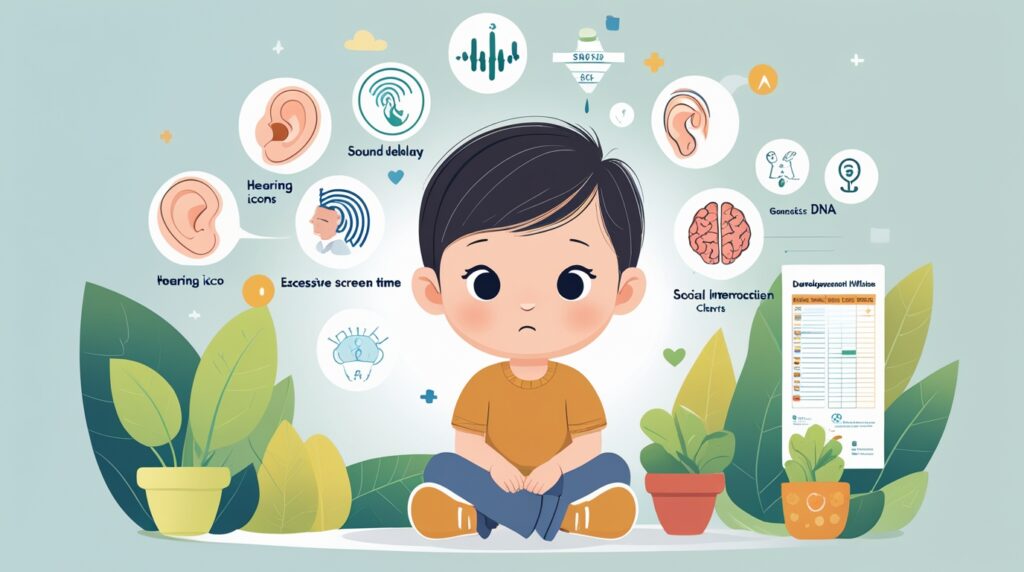
1. Hearing Loss or Auditory Processing Issues
Hearing is fundamental to speech development. Children learn to talk by hearing and imitating the sounds around them.
How hearing problems affect speech:
- Children with hearing loss may not hear speech sounds clearly
- Even mild or intermittent hearing loss during critical language development periods can cause delays
- Chronic ear infections (otitis media) can temporarily affect hearing and language acquisition
- Some children hear sounds but struggle to process and interpret them (auditory processing disorder)
Many parents don’t realize their child has hearing difficulties because the child may respond to some sounds but miss others, particularly softer speech sounds like “s,” “f,” or “th.”
Warning signs of hearing issues:
- Doesn’t respond to their name by 12 months
- Doesn’t turn toward sounds
- History of frequent ear infections
- Speaks very loudly or very quietly
- Says “what?” or “huh?” frequently
- Difficulty following verbal directions
If you suspect hearing loss, an audiologist should evaluate your child before beginning speech therapy in Islamabad. Many children show dramatic improvement once hearing issues are addressed.
2. Oral-Motor Problems
Some children have difficulty coordinating the muscles needed for speech—the tongue, lips, jaw, and soft palate.
Types of oral-motor difficulties:
Dysarthria: Weakness or poor coordination of speech muscles, often due to neurological conditions. Children with dysarthria may speak slowly, slur words, or have difficulty controlling volume.
Apraxia of Speech: The brain struggles to coordinate the precise movements needed for speech, even though the muscles themselves aren’t weak. Children with apraxia know what they want to say but can’t consistently make the right movements. This condition requires specialized speech therapy approaches.
Structural issues: Conditions like cleft palate, tongue-tie (ankyloglossia), or other anatomical differences can physically interfere with speech sound production.
Children with oral-motor problems often benefit from comprehensive therapy that may include both speech therapy and occupational therapy for kids in Islamabad to address related feeding, sensory, and fine motor challenges.
3. Developmental Delays and Intellectual Disabilities
Speech and language development are closely connected to overall cognitive development. Children with global developmental delays or intellectual disabilities often experience speech delays as one symptom of broader challenges.
These children may show delays across multiple areas:
- Cognitive skills (problem-solving, understanding concepts)
- Motor skills (sitting, walking, using hands)
- Social-emotional development
- Adaptive skills (self-care, daily living)
Early intervention is crucial. Research from the World Health Organization (WHO) shows that comprehensive early intervention therapy during the first five years, when the brain is most plastic, produces the best long-term outcomes.
4. Autism Spectrum Disorder (ASD)
Autism is one of the more common causes of significant speech and language delays. The CDC estimates that about 1 in 36 children has autism spectrum disorder.
Speech and language characteristics in autism:
- Delayed language development or no speech at all
- Repeating words or phrases (echolalia) without functional communication
- Difficulty with back-and-forth conversation
- Unusual tone, pitch, or rhythm of speech
- Literal interpretation of language; difficulty understanding jokes, sarcasm, or figurative language
- Challenges with non-verbal communication (gestures, facial expressions, eye contact)
Importantly, speech delay alone doesn’t mean a child has autism. However, when combined with other signs—limited social interaction, restricted interests, repetitive behaviors, sensory sensitivities—autism should be evaluated.
Our autism therapy center in Islamabad provides comprehensive assessment and evidence-based interventions, including behaviour therapy, speech therapy, and family support tailored to each child’s unique profile.
5. Limited Language Exposure and Environmental Factors
Children learn language through interaction. Insufficient exposure to language and conversation can significantly delay speech development.
Environmental factors that impact speech:
Limited interaction: Children need regular, responsive communication with caregivers. Excessive screen time, limited conversation, or environments where children don’t have opportunities to communicate can slow language development.
Language confusion: While bilingualism itself doesn’t cause delays, children learning multiple languages may temporarily have smaller vocabularies in each language. However, if a child shows significant delays in ALL languages they’re exposed to, this suggests a true speech delay rather than normal bilingual development.
Socioeconomic factors: Research shows that children from lower-income families often hear fewer words daily, which can impact vocabulary growth. This “word gap” is preventable through increased conversation, reading, and interaction.
Premature birth or low birth weight: Children born prematurely or with very low birth weight have higher rates of developmental delays, including speech and language difficulties.
The good news? Environmental factors are highly responsive to intervention. Parent training programs and child development therapy in Pakistan can dramatically improve outcomes when families learn strategies to boost language stimulation at home.
6. Childhood Apraxia of Speech (CAS)
While mentioned briefly under oral-motor problems, childhood apraxia deserves special attention as it’s frequently misunderstood.
CAS is a motor speech disorder where the brain struggles to plan and coordinate the precise movements for speech. Unlike dysarthria (muscle weakness), children with apraxia have normal muscle strength but inconsistent errors in sound production.
Characteristics of childhood apraxia:
- Very limited babbling as infants
- Inconsistent speech errors (saying a word correctly once but incorrectly next time)
- Difficulty imitating sounds or words
- Groping movements with the mouth when trying to speak
- Better receptive language (understanding) than expressive language (speaking)
- Slow progress with traditional speech therapy approaches
CAS requires intensive, specialized intervention using specific therapy techniques. At SSR, our speech-language pathologists are trained in evidence-based approaches for apraxia, including PROMPT and other motor-speech interventions.
7. Tongue-Tie and Other Structural Issues
Ankyloglossia (tongue-tie) occurs when the tissue connecting the tongue to the floor of the mouth is too short or tight, restricting tongue movement.
While not all tongue-ties cause speech problems, severe cases can affect:
- Certain speech sounds that require tongue elevation (l, r, t, d, n, z, s)
- Feeding difficulties in infancy
- Articulation clarity
Other structural issues affecting speech include:
- Cleft lip and palate
- Dental malocclusion (significant bite problems)
- Enlarged tonsils and adenoids affecting resonance
These conditions often require multidisciplinary treatment combining medical intervention (surgery, dental work) with speech therapy to achieve optimal outcomes.
8. Psychosocial Factors
Occasionally, emotional or psychological factors contribute to speech delays.
Selective mutism: A child speaks normally in comfortable settings (like home) but remains silent in specific situations (like school). This is an anxiety disorder, not a speech problem, though it requires specialized intervention.
Trauma or extreme stress: Children who’ve experienced significant trauma, neglect, or chronic stress may show regression or delays in speech development.
Severe social anxiety: Some children are so anxious about speaking that they avoid communication, which then impacts their language development.
These situations require a comprehensive approach addressing both the emotional issues and any resulting communication difficulties through behaviour therapy for children in Pakistan alongside speech support.
9. Neurological Conditions
Various neurological conditions can affect speech and language development:
- Cerebral palsy: Affects muscle control and coordination, often impacting speech muscles
- Traumatic brain injury: Depending on location and severity, can affect language processing or speech production
- Genetic syndromes: Down syndrome, Fragile X syndrome, and many others frequently include speech delays as one feature
- Seizure disorders: Some children with epilepsy experience language difficulties
- Progressive neurological conditions: Rare conditions that cause deterioration of skills over time
Children with neurological conditions benefit from comprehensive care at a therapy center for special children in Islamabad where multiple specialists coordinate treatment.
When Speech Delay Has No Clear Cause
Sometimes, despite thorough evaluation, no specific cause for a speech delay can be identified. These children are often called “late bloomers” or diagnosed with “idiopathic language delay.”
While frustrating for parents wanting answers, many of these children catch up to peers with appropriate intervention, especially when speech delay treatment in Pakistan begins early.
Risk Factors for Speech Delay
Certain factors increase a child’s likelihood of experiencing speech delays:
- Family history: Speech and language delays often run in families
- Male gender: Boys are 3-4 times more likely to have speech delays than girls
- Premature birth: Especially before 32 weeks or with very low birth weight
- Multiple birth: Twins and triplets have higher rates of language delays
- Chronic ear infections: Particularly during critical language learning periods (ages 1-3)
- Limited prenatal care: Associated with various developmental risks
- Exposure to toxins: Lead exposure, maternal substance use during pregnancy
Having risk factors doesn’t guarantee a delay, but awareness helps parents monitor development more carefully.
The Importance of Early Identification
Identifying speech delays early is crucial because:
Brain plasticity: Young children’s brains are incredibly adaptable. Early intervention takes advantage of this plasticity, leading to better outcomes.
Preventing secondary problems: Untreated speech delays can lead to:
- Learning difficulties and academic struggles
- Social isolation and peer relationship problems
- Frustration and behavioral challenges
- Lower self-esteem
Better long-term outcomes: Studies consistently show that children receiving early intervention achieve better language skills, academic performance, and social competence than those who wait.
The American Speech-Language-Hearing Association (ASHA) recommends screening all children for speech and language development and seeking evaluation immediately if concerns arise—not taking a “wait and see” approach.
How Speech Delays Are Diagnosed
Professional evaluation typically includes:
Case history: Detailed information about pregnancy, birth, medical history, and developmental milestones
Hearing screening: Ruling out hearing loss as a contributing factor
Oral-motor examination: Assessing the structure and function of the mouth, tongue, and palate
Standardized testing: Age-appropriate assessments measuring:
- Receptive language (understanding)
- Expressive language (speaking)
- Articulation and phonology (speech sounds)
- Pragmatic language (social communication)
Play-based observation: For younger children, observing natural communication during play
Parent interview: Understanding communication in daily life, which may differ from formal testing
At Special School of Recovery, our comprehensive assessment process identifies not just whether a delay exists, but why, allowing us to create targeted, effective treatment plans.
What Parents Can Do
While professional help is essential, parents play the most important role in their child’s speech development:
For all ages:
- Talk throughout daily routines, narrating what you’re doing
- Read together every single day
- Respond enthusiastically to all communication attempts
- Reduce screen time; prioritize face-to-face interaction
- Play interactive games that encourage communication
- Sing songs and nursery rhymes
Avoid these common mistakes:
- Anticipating needs before the child asks (give them reason to communicate)
- Accepting gestures when you know they can use words
- Speaking for your child in social situations
- Using baby talk instead of clear, correct speech
- Pressuring or correcting constantly (this causes frustration and withdrawal)
Know when to seek help: If your child shows any of these warning signs, don’t delay evaluation:
- No babbling by 12 months
- No words by 15-18 months
- Fewer than 50 words by age 2
- Not combining words by 30 months
- Speech is very unclear by age 3
- Regression or loss of previously acquired skills
- Frustration with communication
Treatment Options for Speech Delays
Treatment depends entirely on the underlying cause and individual needs.
Speech-language therapy: The primary intervention for most speech delays, using play-based and structured activities to build communication skills
Behaviour therapy: Particularly important for children with autism or those who need help with attention, social skills, or learning readiness
Occupational therapy: Addresses sensory issues, fine motor skills, and feeding difficulties that may accompany speech delays
Hearing aids or cochlear implants: For children with hearing loss
Medical or surgical intervention: Treating ear infections, removing enlarged tonsils/adenoids, or correcting structural problems
Parent training: Teaching families strategies to boost language development throughout daily life
Educational support: Individualized Education Plans (IEPs) ensuring appropriate support in school settings
The most effective approach combines multiple therapies addressing the whole child. Our comprehensive services at SSR include speech therapy, behaviour therapy, and occupational therapy, allowing coordinated, multidisciplinary care under one roof.
The Role of Behaviour Therapy
Many children with speech delays also benefit from behaviour therapy in Islamabad, particularly those with:
- Autism spectrum disorder
- ADHD and attention difficulties
- Challenging behaviors stemming from communication frustration
- Social communication deficits
- Learning difficulties
Behaviour therapy techniques like Applied Behavior Analysis (ABA) can be integrated with speech therapy to teach functional communication skills, reduce maladaptive behaviors, and increase learning readiness.
Why Choose Professional Help
Some parents wonder if their child will simply “catch up” without intervention. While some late talkers do catch up, many don’t—and there’s no reliable way to predict which children will outgrow delays naturally.
Benefits of professional speech therapy:
- Correct identification of the specific problem
- Evidence-based intervention techniques
- Faster progress than waiting
- Prevention of secondary academic and social problems
- Parent education and home strategy coaching
- Regular progress monitoring with adjustments as needed
Research consistently shows that children receiving appropriate therapy make significantly more progress than those who don’t receive intervention.
Frequently Asked Questions
What causes speech delays in children? Common causes include hearing loss, oral-motor problems, autism spectrum disorder, developmental delays, limited language exposure, apraxia of speech, neurological conditions, and sometimes no identifiable cause. Professional evaluation determines the specific reason for each child.
Can speech delays be corrected? Yes, most speech delays improve significantly with appropriate intervention, especially when treatment begins early. The outcome depends on the underlying cause, severity, and age when therapy starts.
How do I know if my child has a speech delay? Compare your child’s communication to typical milestones. If they’re not using words by 18 months, combining words by age 2, or speaking clearly enough for strangers to understand by age 3, seek evaluation.
Do speech delays mean autism? No, speech delay alone doesn’t indicate autism. However, when combined with limited social interaction, repetitive behaviors, and restricted interests, autism evaluation is warranted. Many children have speech delays without autism.
How long does speech therapy take? Duration varies widely based on the cause and severity of the delay. Some children need a few months of therapy, while others benefit from ongoing support for years. Regular progress monitoring helps determine appropriate therapy duration.
Should I wait to see if my child catches up? Experts recommend against “wait and see” approaches. Early evaluation and intervention lead to better outcomes. Even if therapy isn’t needed, evaluation provides peace of mind and strategies to support development at home.
Taking Action: Next Steps
If you’re concerned about your child’s speech development, trust your instincts. Parents often recognize problems before formal screening catches them.
Steps to take today:
- Document your concerns with specific examples
- Schedule a hearing test to rule out hearing loss
- Contact a qualified speech-language pathologist for evaluation
- Discuss concerns with your pediatrician
- Begin implementing language-rich activities at home
Early action makes a profound difference. Children who receive intervention before age 3 typically show better outcomes than those who start later.
How Special School of Recovery Can Help
At SSR, we understand how worried parents feel when their child isn’t talking as expected. Our compassionate, experienced team provides:
- Comprehensive speech and language evaluation
- Thorough assessment to identify underlying causes
- Evidence-based therapy customized to each child’s needs
- Parent training and home activity coaching
- Coordination with other specialists when needed
- Ongoing progress monitoring and plan adjustments
- Family-centered care respecting Pakistani culture and values
We serve families throughout Islamabad, Rawalpindi, and across Pakistan, offering accessible, affordable, high-quality services for children with speech delays and other developmental needs.
Our multidisciplinary approach means children receive coordinated care addressing all areas of development—speech, behavior, sensory processing, motor skills, and social-emotional growth—in one trusted location.
Moving Forward with Hope
Discovering your child has a speech delay can feel overwhelming, but remember: early intervention works. With the right support, most children with speech delays make tremendous progress and go on to communicate effectively.
Your child’s journey is unique. Some children need brief intervention and catch up quickly. Others require longer-term support. Either way, getting help early gives your child the best possible chance at success in school, friendships, and life.
You’re not alone in this journey. Thousands of families navigate speech delays every year, and with professional guidance, patience, and consistent support, children develop the communication skills they need to thrive.
Book an assessment today at Special School of Recovery (SSR), Islamabad and give your child the support they deserve.
Contact us to schedule your child’s comprehensive speech and language evaluation. Our team is ready to answer your questions, address your concerns, and create a personalized plan to help your child find their voice.
Special School of Recovery (SSR) provides specialized speech therapy, behaviour therapy, and occupational therapy for children with developmental delays, autism, and special needs throughout Islamabad, Rawalpindi, and Pakistan. Our evidence-based approach combines expert clinical care with compassionate family support. Visit ssr.org.pk to learn more and begin your child’s journey toward better communication.