Every parent dreams of hearing their child’s first words, sharing stories, and watching them express their thoughts and feelings. But when a child struggles to communicate, it can feel overwhelming and isolating. If you’ve noticed your little one having difficulty speaking, pronouncing words, or expressing themselves, you’re not alone—and there’s hope.
Speech therapy is a powerful tool that helps children overcome communication challenges and build the language skills they need to thrive. At Special School of Recovery (SSR) in Islamabad, we’ve witnessed countless children transform from frustrated, quiet toddlers into confident communicators who can share their world with everyone around them.
What Is Speech Therapy and How Does It Work?
Speech therapy, also called speech and language therapy, is a specialized treatment that helps children develop better communication skills. A speech-language pathologist (SLP) works with children who have difficulty with speech sounds, language comprehension, or expressing their thoughts.
The therapy focuses on several key areas:
Articulation and pronunciation – helping children produce sounds correctly so others can understand them. Many children struggle with specific sounds like “r,” “s,” or “th,” which can make their speech unclear.
Language development – building vocabulary and helping children understand and use words appropriately. This includes both receptive language (understanding what others say) and expressive language (sharing their own ideas).
Fluency – addressing stuttering or other speech rhythm issues that can make communication frustrating for children.
Voice quality – ensuring children use appropriate pitch, volume, and tone when speaking.
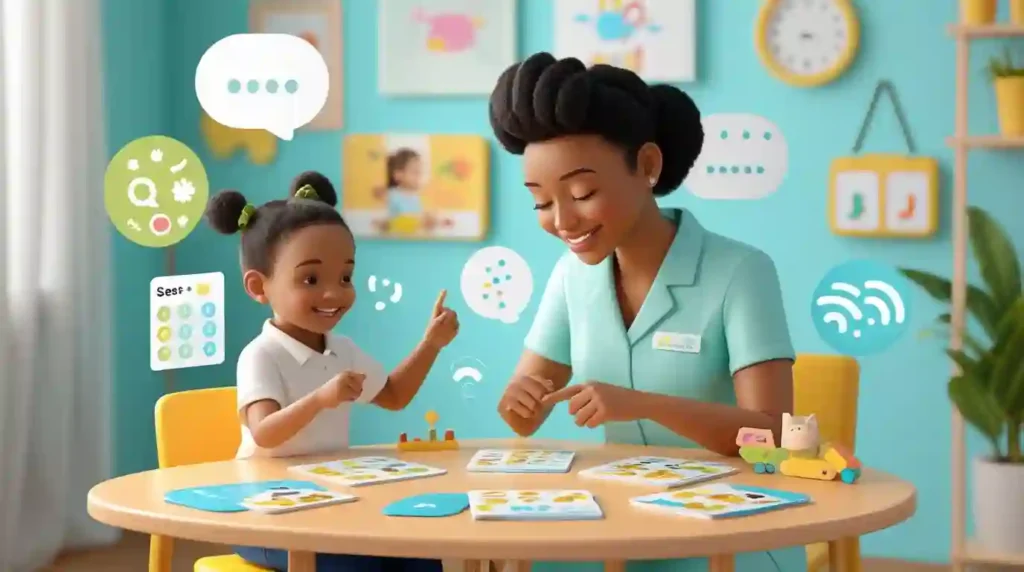
During speech therapy sessions, trained therapists use games, activities, and exercises tailored to each child’s specific needs. The approach is always playful and engaging because children learn best when they’re having fun. Parents often don’t realize that what looks like playtime is actually carefully designed therapy that targets specific communication goals.
Common Communication Disorders in Children
Understanding the types of speech and communication difficulties can help parents recognize when their child might benefit from professional support.
Articulation disorders occur when children have trouble making certain sounds. They might substitute one sound for another (saying “wabbit” instead of “rabbit”) or leave sounds out entirely. These pronunciation problems can affect how well others understand the child.
Language delays mean a child’s language skills aren’t developing at the expected pace. They might have a limited vocabulary, struggle to form sentences, or have difficulty following instructions. Early intervention therapy can make a significant difference for children with language delays.
Stuttering and fluency disorders involve disruptions in the normal flow of speech. Children might repeat sounds, prolong words, or get stuck trying to say certain words. This can be particularly frustrating for children who know what they want to say but struggle to get the words out.
Apraxia of speech is a motor speech disorder where children have difficulty planning and coordinating the movements needed for speech. Their brain knows what they want to say, but struggles to tell their mouth how to make the sounds.
Voice disorders affect the quality, pitch, or volume of a child’s voice. Some children speak too softly to be heard, while others may sound hoarse or strained.
Many children with autism spectrum disorder, Down syndrome, cerebral palsy, or ADHD also experience communication challenges that benefit from speech therapy. At our therapy center for special children in Islamabad, we provide comprehensive support for all types of communication disorders.
The Real Benefits of Speech Therapy for Children
The impact of effective speech therapy extends far beyond just clearer pronunciation. When children can communicate better, their entire world opens up.
Academic success improves dramatically when children can express their ideas, ask questions, and understand instructions. Speech and language skills are the foundation for reading, writing, and learning across all subjects. Children who receive early intervention therapy often perform better in school because they can fully participate in classroom activities.
Social connections become easier when children can communicate with peers. Many children with speech difficulties feel isolated or frustrated because they struggle to make friends or join in conversations. Improving their talking skills helps them build relationships and feel included.
Emotional well-being improves when children can express their feelings and needs. A child who can’t communicate effectively may become frustrated, anxious, or withdrawn. Speech therapy gives them the tools to share their emotions and get their needs met, reducing behavioral issues and improving overall mental health.
Confidence and self-esteem grow as children master new communication skills. There’s nothing quite like seeing a child’s face light up when they successfully say a word they’ve been practicing or when someone understands them clearly for the first time.
Independence increases as children learn to advocate for themselves. Being able to ask for help, make choices, and express preferences are essential life skills that speech therapy helps develop.
Research consistently shows that children who receive speech therapy show measurable improvements in communication abilities. According to the American Speech-Language-Hearing Association (ASHA), early intervention is particularly effective—children who start therapy before age three often catch up to their peers more quickly.
What Happens During a Speech Therapy Session?
Many parents wonder what actually takes place during therapy appointments. Understanding the process can help you feel more comfortable and know what to expect.
Initial assessment is the first step. A qualified speech therapist will evaluate your child’s current communication abilities through observation, standardized tests, and conversation. They’ll assess oral motor skills, language comprehension, vocabulary, and speech clarity. This evaluation helps create an individualized treatment plan tailored to your child’s unique needs.
Therapy activities are designed to be engaging and age-appropriate. For younger children, therapists might use toys, books, songs, and games. They might practice specific sounds through play, encourage vocabulary building with picture cards, or use puppets to model conversation skills. Older children might work on more complex language tasks like storytelling, following multi-step directions, or practicing social communication.
Parent involvement is crucial for success. Therapists will teach you activities and strategies to practice at home. Consistency between therapy sessions and daily life helps children progress faster. Many parents are surprised to learn they play such an important role in their child’s improvement.
Progress monitoring happens regularly. Your therapist will track your child’s development and adjust the treatment plan as needed. They’ll share updates about what’s working well and where your child needs additional support.
Sessions typically last 30 to 60 minutes and occur once or twice weekly, though frequency varies based on individual needs. At Special School of Recovery in Islamabad, our speech therapists work closely with families to create a schedule that fits your life while providing the support your child needs.
Signs Your Child Might Need Speech Therapy
Parents often ask how to know if their child’s speech development is on track. While every child develops at their own pace, certain signs suggest professional evaluation might be helpful.
By age 2, children should be using at least 50 words and beginning to combine two words (“more milk,” “daddy go”). If your toddler isn’t talking much or only uses a few words, speech therapy for toddlers can help address early speech delay.
By age 3, children should be speaking in short sentences and be understood by family members most of the time. Speech that’s difficult for parents to understand may indicate an articulation disorder.
By age 4, children should speak clearly enough that strangers can understand them about 75% of the time. They should use complex sentences and tell simple stories.
Other warning signs include:
- Frustration when trying to communicate
- Not responding to their name or simple questions
- Limited eye contact during communication
- Difficulty following age-appropriate instructions
- Repeating sounds or words frequently (stuttering)
- Loss of previously acquired speech skills
- Drooling or difficulty eating (may indicate oral motor issues)
Children with autism, hearing impairment, developmental delays, or neurological conditions often benefit from comprehensive speech and language therapy. If you notice any concerning signs, trust your instincts. Early evaluation and intervention can prevent small issues from becoming larger challenges.
Speech Therapy in Islamabad, Pakistan: Finding the Right Support
For families in Islamabad, Rawalpindi, and across Pakistan, finding quality speech therapy services is an important step in supporting your child’s development.
When searching for a speech therapist in Islamabad, look for professionals with proper qualifications and experience working with children. Licensed speech-language pathologists should have specialized training in pediatric speech therapy and understand child development.
Special School of Recovery (SSR) in Islamabad offers comprehensive therapy services for children with various communication needs. Our team includes experienced speech therapists who work alongside occupational therapists and behavior therapists to provide holistic support. This multidisciplinary approach ensures we address all aspects of your child’s development.
We serve families from Islamabad, Rawalpindi, and surrounding areas, offering convenient access to professional therapy services. Our facility is designed specifically for children, creating a welcoming, supportive environment where they feel comfortable and motivated to learn.
Many parents also search for “speech therapy centers near me” or “best speech therapist Islamabad” when beginning their journey. While location matters, the quality of care and the therapist’s approach are equally important. Look for centers that:
- Provide individualized assessment and treatment plans
- Encourage parent participation and training
- Use evidence-based therapy techniques
- Offer regular progress updates
- Create a positive, encouraging environment
Cost is often a concern for families. Speech therapy costs in Pakistan vary depending on location and services provided. At SSR, we believe every child deserves access to quality therapy, and we work with families to make our services accessible.
Speech Therapy Techniques Parents Can Use at Home
Professional therapy sessions are essential, but daily practice at home accelerates progress. Here are practical strategies you can start using today:
Talk throughout the day about what you’re doing. Narrate daily activities like cooking, getting dressed, or playing. This constant language exposure helps children learn new words naturally. Say things like, “I’m putting the red shirt on. It goes over your head. Now your arms go through the sleeves.”
Read together every day. Books expose children to new vocabulary and language structures. Point to pictures, ask questions, and encourage your child to tell you about the story. Make reading interactive and fun.
Expand their sentences. When your child says something, repeat it back with more detail. If they say “dog,” you might say, “Yes, that’s a big brown dog running in the park.” This modeling helps them learn more complex language.
Sing songs and nursery rhymes. Music and rhythm make language learning enjoyable and help with phonological awareness. Songs also teach patterns and repetition.
Practice specific sounds your therapist is working on. Make it playful—find toys or objects that start with that sound, or create silly sentences using the target sound.
Give choices to encourage communication. Instead of anticipating every need, offer options: “Do you want the red cup or the blue cup?” This motivates children to use their words.
Be patient and encouraging. Avoid correcting constantly, which can be discouraging. Instead, model the correct pronunciation naturally in your response. Celebrate all attempts at communication.
Reduce screen time and increase face-to-face interaction. Real conversations with real people are how children learn language best.
These home exercises complement professional therapy and help children generalize their new skills to everyday situations. Your speech therapist at SSR will provide specific activities tailored to your child’s needs.
Understanding the Timeline: How Long Does Speech Therapy Take?
One of the most common questions parents ask is how long therapy will take. The honest answer is that it varies significantly based on several factors.
The severity of the speech delay or disorder plays a major role. A child with mild articulation issues might need a few months of therapy, while a child with a complex language disorder or apraxia might require several years of support.
Age at which therapy begins matters tremendously. Children who start speech therapy early, especially before age three, typically progress faster than those who begin later. Early childhood is a critical period for language development.
Consistency of practice affects outcomes. Children who attend regular sessions and practice at home consistently progress more quickly than those with irregular attendance or minimal home reinforcement.
Individual differences mean each child responds to therapy at their own pace. Some children make rapid gains, while others progress more gradually. Both paths are normal and acceptable.
Most children attend therapy once or twice weekly. Some see noticeable improvement within a few months, while others need longer-term support. Your therapist will set realistic goals and provide regular updates about progress.
The good news is that speech therapy is highly successful. Research shows that most children who receive appropriate intervention improve significantly. The key is patience, consistency, and trust in the process.
Why Choose Special School of Recovery for Speech Therapy in Islamabad
Choosing the right therapy center is one of the most important decisions you’ll make for your child. Special School of Recovery (SSR) stands out as a leading special education school in Islamabad for several reasons.
Experienced professionals with specialized training in pediatric speech therapy work with your child. Our speech-language pathologists stay current with the latest research and therapy techniques.
Comprehensive services under one roof mean your child can receive speech therapy, occupational therapy for children, and behavior therapy all in the same location. This integrated approach addresses all aspects of development.
Family-centered care is at the heart of everything we do. We partner with parents, providing training and support so you can continue therapy at home. We know that parents are their child’s first and most important teachers.
Individualized treatment plans ensure your child receives therapy tailored to their specific needs and goals. We don’t believe in one-size-fits-all approaches.
Evidence-based practices guide our therapy methods. We use techniques proven effective by research while remaining flexible and creative to engage each unique child.
Supportive environment helps children feel safe and motivated. Our facility is designed for children, with bright colors, engaging materials, and a welcoming atmosphere.
We’re proud to serve families throughout Islamabad, Rawalpindi, and beyond, helping children overcome communication challenges and reach their full potential.
Frequently Asked Questions About Speech Therapy
What age should a child start speech therapy? Children can start speech therapy as early as six months if concerns exist. However, most children begin between ages 18 months and 4 years. The earlier intervention starts, the better the outcomes typically are.
How do I know if my child needs speech therapy? If your child isn’t meeting speech milestones, has difficulty being understood, shows frustration when communicating, or has been diagnosed with a developmental condition affecting speech, an evaluation is recommended.
Can speech delay be cured? Many speech delays can be successfully treated, especially with early intervention. While “cure” isn’t always the right term, most children make significant improvements and develop functional communication skills.
What causes speech delay in children? Causes vary and include hearing impairment, developmental disorders, oral motor problems, neurological conditions, or environmental factors. Sometimes no specific cause is identified.
How often should a child attend speech therapy? Most children benefit from one to two sessions per week, though frequency depends on individual needs. Your therapist will recommend an appropriate schedule.
What qualifications should a speech therapist have? Look for licensed speech-language pathologists with specialized training in pediatric therapy. They should have a degree in speech-language pathology and relevant clinical experience.
Is speech therapy only for speech sounds? No, speech therapy addresses all aspects of communication including understanding language, using words appropriately, social communication, and even nonverbal communication for children who can’t speak.
Take the First Step Toward Better Communication
Watching your child struggle to communicate is heartbreaking, but you don’t have to navigate this journey alone. Speech therapy provides proven strategies to help children develop the language skills they need to express themselves, connect with others, and succeed in life.
Every child deserves the opportunity to share their thoughts, tell their stories, and be understood. Whether your child has a mild pronunciation difficulty or a more complex communication disorder, professional support can make a transformative difference.
The team at Special School of Recovery understands the challenges your family faces and the hopes you have for your child’s future. Our experienced speech therapists in Islamabad are ready to partner with you, providing compassionate, effective therapy that meets your child exactly where they are and helps them grow.
Don’t wait to see if your child will “grow out of it.” Early intervention produces the best outcomes. The sooner your child receives appropriate support, the faster they’ll develop the communication skills that will serve them throughout their lives.
Book an assessment today at Special School of Recovery (SSR), Islamabad and give your child the support they deserve. Visit our website at ssr.org.pk to explore our speech, behaviour and occupational therapy services, or contact us to schedule an evaluation. Together, we can help your child find their voice and communicate with confidence.
Your child’s journey to better communication starts here. Let’s take that first step together.