
A Comprehensive Guide for Parents in Islamabad
As a parent of a child with special needs in Islamabad, you want to provide the best possible support for your child’s development. While professional occupational therapy for kids in Islamabad is essential, the activities you do at home can significantly reinforce and enhance the progress made during therapy sessions. This guide explores practical, evidence-based daily activities that complement professional occupational therapy and support your child’s overall development.
Whether your child is receiving speech therapy in Islamabad, behaviour therapy for children in Pakistan, or comprehensive developmental support at a therapy center for special children in Islamabad, incorporating therapeutic activities into your daily routine can make a meaningful difference in their progress.
Understanding Occupational Therapy for Children
Occupational therapy focuses on helping children develop the skills they need for daily living and learning. For children with autism spectrum disorder, developmental delays, sensory processing challenges, or learning disabilities, occupational therapy addresses crucial areas including fine motor skills, sensory integration, self-care abilities, and social interaction.
Many families in Islamabad and Rawalpindi seek support from specialized facilities offering early intervention therapy in Pakistan. According to the World Health Organization (WHO), early intervention significantly improves developmental outcomes for children with special needs. Research shows that when therapeutic activities are practiced consistently at home, children make faster progress and better generalize skills across different environments.
The key to successful home-based occupational therapy support lies in making activities natural, enjoyable, and part of your daily routine. This approach ensures consistent practice without overwhelming your child or adding stress to your family life.
Morning Routine Activities for Occupational Therapy
Dressing Skills Development
Getting dressed each morning offers excellent opportunities for developing fine motor skills and independence. These activities support the goals typically addressed in occupational therapy for kids in Islamabad and can be adapted to your child’s current abilities.
Start with simple tasks and gradually increase complexity:
- Practice pulling pants up and down, which strengthens bilateral coordination and body awareness
- Work on large buttons before moving to smaller ones, developing pincer grasp and hand-eye coordination
- Use Velcro shoes initially, then progress to slip-on shoes, and finally laced shoes as skills improve
- Teach pulling shirts over the head by starting with oversized shirts and providing verbal cues
- Encourage choosing clothes to build decision-making skills and independence
For children who also receive behaviour therapy in Islamabad, visual schedules showing the dressing sequence can reduce frustration and increase independence. Break down each step and celebrate small victories to build confidence and motivation.
Hygiene and Self-Care Routines
Personal care activities are fundamental life skills that occupational therapy addresses. These daily routines provide consistent practice opportunities for motor planning, sensory processing, and task sequencing.
Incorporate these activities into your morning routine:
- Tooth brushing strengthens oral motor skills and can be paired with communication practice for children receiving speech therapy
- Face washing teaches body awareness and the proper amount of pressure to use during self-care
- Hair combing develops bilateral coordination as children learn to hold the comb and style their hair
- Hand washing reinforces proper sequencing and can incorporate sensory exploration with different soap textures
- Using mirrors helps children become more aware of their body and facial expressions
These seemingly simple activities build the foundation for greater independence and confidence in your child’s ability to care for themselves.
Mealtime Activities Supporting Development
Food Preparation and Kitchen Skills
Involving your child in meal preparation offers rich opportunities for developing multiple skills simultaneously. These activities are especially valuable for children working on sensory integration, fine motor control, and following multi-step directions.
Age-appropriate kitchen activities include:
- Spreading butter or jam on bread strengthens wrist stability and hand strength
- Pouring liquids from one container to another develops hand-eye coordination and motor planning
- Mixing ingredients in a bowl promotes bilateral coordination and crossing midline
- Using cookie cutters exercises hand strength and provides tactile sensory input
- Peeling fruits like bananas or oranges builds finger strength and bilateral skills
- Tearing lettuce for salads offers a safe cutting activity for younger children
- Measuring ingredients introduces early math concepts alongside motor skills
For children receiving services at an autism therapy center in Islamabad, these structured activities can help with sensory sensitivities around food while building practical life skills. The predictable nature of cooking activities can be especially comforting for children who thrive on routine.
Developing Eating and Utensil Skills
Mealtimes provide natural opportunities to work on oral motor skills, self-feeding, and social interaction. Children who struggle with speech delay treatment in Pakistan often benefit from oral motor exercises integrated into eating activities.
Support eating skill development through:
- Using adapted utensils with thicker handles or grips if your child has difficulty with standard utensils
- Practicing with divided plates to help with portion control and reducing overwhelm
- Introducing different food textures gradually to address sensory sensitivities
- Encouraging drinking from an open cup to strengthen oral muscles needed for speech
- Creating a calm, predictable mealtime environment to reduce anxiety and behavioral challenges
- Modeling proper eating behaviors as children learn through observation
Remember that progress may be gradual. Celebrate small victories, like trying a new texture or using a utensil independently for the first time.
Play-Based Activities for Skill Development
Fine Motor Play Activities
Play is the primary occupation of childhood and offers countless opportunities for therapeutic practice. Special education schools in Islamabad often incorporate these activities into their programming, but they’re equally valuable at home.
Effective fine motor play activities include:
- Playing with playdough, clay, or putty strengthens hand muscles and provides calming sensory input
- Stringing beads develops hand-eye coordination, bilateral coordination, and visual motor skills
- Using tweezers or tongs to pick up small objects builds the tripod grasp needed for writing
- Completing puzzles improves visual perception, problem-solving, and spatial awareness
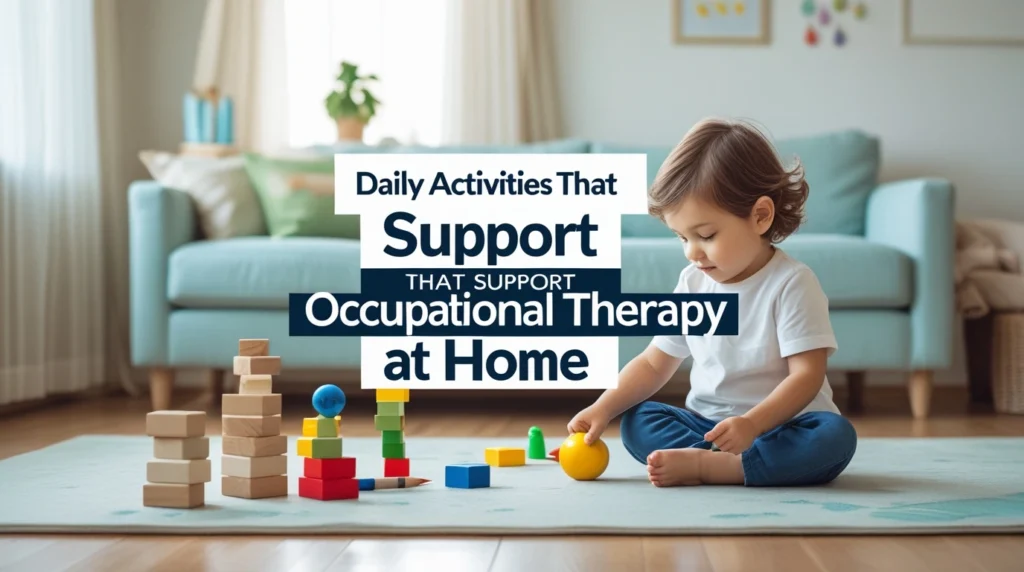
- Building with blocks or construction toys enhances planning, sequencing, and creativity
- Threading laces through cards prepares children for shoe-tying and improves hand-eye coordination
- Playing with pegboards strengthens pincer grasp and visual-motor integration
These activities can be easily adapted to your child’s current skill level. Start with larger objects and gradually move to smaller, more challenging tasks as abilities improve.
Gross Motor and Movement Activities
Large muscle activities are essential for overall development and provide important sensory input. These activities particularly benefit children working with a child behaviour therapist in Islamabad on self-regulation and attention skills.
Incorporate these gross motor activities daily:
- Jumping on a small trampoline or cushions provides vestibular input and builds leg strength
- Walking on a balance beam or line on the floor develops balance and body awareness
- Playing catch with different sized balls improves motor planning and visual tracking
- Crawling through tunnels or under furniture strengthens core muscles and spatial awareness
- Dancing to music combines movement, rhythm awareness, and joyful social interaction
- Animal walks like bear crawls or crab walks build strength and coordination
- Obstacle courses using household items challenge planning and sequencing abilities
These activities also help children release energy in productive ways, which can improve focus and behavior throughout the day.
Sensory Integration Activities at Home
Many children receiving child development therapy in Pakistan have sensory processing differences that affect their daily functioning. The American Occupational Therapy Association (AOTA) emphasizes that sensory integration activities can help children better process and respond to sensory information.
Creating a Sensory-Friendly Home Environment
Support your child’s sensory needs through:
- Establishing a quiet corner with soft textures, dim lighting, and calming activities for when your child feels overwhelmed
- Providing weighted blankets or lap pads that offer calming deep pressure input
- Using noise-canceling headphones in busy or loud environments
- Creating predictable routines that help your child know what to expect throughout the day
- Offering fidget toys or chewable jewelry for children who seek oral or tactile input
- Adjusting lighting to avoid harsh fluorescent lights that may be overwhelming
- Using visual timers to help children understand time and transitions
These environmental modifications can significantly reduce stress and help your child feel more comfortable and regulated throughout the day.
Daily Sensory Activities
Incorporate these sensory-rich activities into your routine:
- Tactile play with rice, beans, sand, or water provides exploration opportunities and can be calming or alerting depending on the activity
- Heavy work activities like pushing a loaded laundry basket, carrying groceries, or helping move furniture provide organizing proprioceptive input
- Movement activities such as swinging, spinning, or rocking offer vestibular input that helps with balance and spatial awareness
- Quiet activities like reading together, listening to calming music, or gentle massage can help with regulation before bedtime
- Sensory bins with different materials allow safe exploration of various textures
- Blowing bubbles or whistles strengthens oral motor skills while providing fun sensory experiences
The Centers for Disease Control and Prevention (CDC) notes that sensory activities can help children with autism and other developmental differences better engage with their environment and learning activities.
Academic and Pre-Academic Skills
Pre-Writing Activities
For children attending a special education school in Islamabad or preparing for mainstream education, home activities can support the development of skills needed for academic success.
Build pre-writing skills through:
- Coloring within large areas, gradually moving to smaller spaces
- Tracing lines, shapes, and letters to develop pencil control
- Drawing circles, lines, and simple shapes to build the foundation for letter formation
- Using vertical surfaces like easels or walls, which naturally strengthen shoulder and wrist muscles
- Playing with chalk on sidewalks offers large-scale practice and sensory input
- Finger painting builds hand strength and bilateral coordination
These activities prepare children for the fine motor demands of handwriting while keeping practice enjoyable and stress-free.
Early Literacy and Communication Support
Support language and literacy development alongside speech therapy in Islamabad:
- Reading together daily builds vocabulary, listening skills, and bonding
- Pointing to and naming pictures in books supports word learning
- Asking open-ended questions about stories encourages expressive language
- Singing songs and rhymes builds phonological awareness
- Playing sound games like identifying initial sounds in words
- Using picture communication cards for children with limited verbal abilities
- Creating photo books about daily activities to support language development
These activities create a language-rich environment that complements formal speech therapy services.
Household Chores as Therapy Activities
Age-Appropriate Responsibilities
Household tasks offer wonderful opportunities for skill building. Children receiving behaviour therapy in Rawalpindi or Islamabad can benefit from the structure and sense of accomplishment these activities provide.
Appropriate chores include:
- Sorting laundry by color teaches categorization and visual discrimination
- Matching socks builds visual matching and fine motor skills
- Setting the table reinforces counting, one-to-one correspondence, and following directions
- Helping load the dishwasher teaches spatial awareness and sequencing
- Dusting low surfaces provides proprioceptive input and builds responsibility
- Watering plants develops careful motor control and nurturing behaviors
- Putting away groceries practices categorization and following instructions
These tasks help children feel like valued family members while naturally building important life skills.
Organizing and Sorting Activities
Organization tasks support cognitive and motor development:
- Sorting toys into categories builds classification skills
- Organizing books by size or color teaches comparison and ordering
- Matching containers with lids develops problem-solving and spatial skills
- Putting away clean silverware practices sorting and fine motor control
- Arranging items in drawers teaches organization and planning
These activities make skill-building feel purposeful rather than like “therapy work.”
Social Skills and Communication Activities
Family Interaction Opportunities
Daily family interactions provide natural contexts for developing social skills that complement behaviour therapy for children in Pakistan.
Practice social skills through:
- Family mealtimes where everyone shares about their day
- Turn-taking games that teach waiting and sharing
- Cooperative activities like cooking together or building projects
- Role-playing common social situations to build confidence
- Video modeling showing appropriate social behaviors
- Practicing greetings and farewells with family members
- Learning to ask for help appropriately when needed
These interactions build the foundation for successful peer relationships and community participation.
Community Participation
Gradually expose your child to community activities with appropriate support:
- Shopping trips that practice following directions and social awareness
- Park visits for social observation and parallel play opportunities
- Library story time for group participation in a structured setting
- Places of worship to practice quiet sitting and group participation
- Restaurants to practice appropriate public behavior
- Community events appropriate to your child’s sensory tolerance
Start with short visits and gradually increase duration as your child becomes more comfortable.
Evening Routine Activities
Calming Activities Before Bed
Establish a consistent bedtime routine that promotes good sleep, which is essential for learning and development:
- Warm bath time provides calming sensory input and practice with self-care
- Gentle massage offers deep pressure and relaxation
- Reading calm stories creates a peaceful transition to sleep
- Dimming lights signals the body it’s time to wind down
- Playing soft music or white noise helps with sensory regulation
- Simple stretches or yoga poses release tension from the day
- Deep breathing exercises teach self-regulation techniques
Children working with a child psychologist in Islamabad on anxiety or behavioral challenges often benefit significantly from predictable, calming bedtime routines.
Creating a Structured Daily Schedule
Visual Schedules and Routines
Visual supports help children understand expectations and reduce anxiety:
- Use pictures or photos showing each activity in sequence
- Include transition warnings like “5 more minutes” timers
- Make schedules predictable but flexible enough for special events
- Review the schedule together each morning
- Check off completed activities for a sense of accomplishment
- Prepare children for changes in routine when possible
Visual schedules are especially helpful for children receiving services at a therapy center for special children in Islamabad, as they bridge the structured therapy environment and home.
Balancing Structure and Flexibility
While routine is important, building in flexibility helps children develop coping skills:
- Plan for “choice time” where children select activities
- Allow some unstructured play for creativity and relaxation
- Teach coping strategies for when plans change unexpectedly
- Model flexibility in your own responses to changes
- Celebrate successful adaptations to reinforce resilience
This balance prepares children for the unpredictability of real life while providing the security of routine.
Working with Your Therapy Team
Communicating with Therapists
Strong collaboration with your child’s therapy team enhances progress:
- Share observations about what works well at home
- Ask for specific home activities that target current goals
- Report challenges you’re experiencing so therapists can provide strategies
- Request demonstrations of techniques you can use at home
- Keep a simple log of activities and your child’s responses
- Attend parent training sessions offered by your therapy center
Whether your child receives services through an occupational therapy clinic in Islamabad or another facility, open communication ensures everyone works toward the same goals.
Tracking Progress at Home
Monitor your child’s development to celebrate successes and identify areas needing additional support:
- Take videos of your child performing skills to share with therapists
- Note new skills as they emerge, no matter how small
- Track challenging behaviors to identify patterns and triggers
- Celebrate milestones to maintain motivation
- Adjust activities as skills improve or challenges arise
- Share successes with your child’s entire support team
This information helps therapists adjust treatment plans and ensures therapy remains targeted to your child’s current needs.
Frequently Asked Questions
What activities can I do at home to support my child’s occupational therapy?
Daily activities like dressing, meal preparation, play with playdough, household chores, and outdoor activities all support occupational therapy goals. Focus on activities that practice fine motor skills, sensory processing, self-care, and motor planning in natural contexts.
How often should I practice occupational therapy activities at home?
Integrate therapeutic activities throughout your daily routine rather than setting aside specific “therapy time.” Aim for consistent practice during normal activities like meals, hygiene routines, play, and chores. Quality and consistency matter more than duration.
Can home activities really make a difference in my child’s development?
Yes. Research shows that consistent practice at home significantly enhances therapy outcomes. Children who practice skills in natural environments generalize those skills better than those who only practice in clinical settings.
What if my child resists doing therapy activities at home?
Make activities fun and game-like rather than feeling like work. Follow your child’s interests, offer choices, keep sessions short, and provide plenty of positive reinforcement. If resistance continues, discuss strategies with your occupational therapist.
How do I know if an activity is too challenging for my child?
Activities should be achievable with some effort but not so difficult that they cause frustration. If your child shows signs of stress, simplify the activity. Your occupational therapist can help you find the right challenge level.
Should I correct my child’s mistakes during activities?
Focus on effort and small improvements rather than perfection. Provide gentle guidance and support rather than frequent corrections. The goal is building skills and confidence, not perfection.
How can I incorporate sensory activities for my child with autism?
Create sensory bins with different textures, offer movement opportunities like jumping or swinging, provide heavy work activities like carrying groceries, and establish a quiet sensory space. Observe what input calms or alerts your child and adjust accordingly.
What’s the difference between occupational therapy and speech therapy?
Occupational therapy focuses on daily living skills, fine and gross motor development, and sensory processing. Speech therapy addresses communication, language, and oral motor skills. Many children benefit from both therapies working together.
How long does it take to see progress from home activities?
Progress timelines vary by child and specific goals. Some skills improve within weeks, while others take months of consistent practice. Regular communication with your therapy team helps track progress and adjust strategies.
Where can I find professional support in Islamabad for my child?
Special School of Recovery (SSR) in Islamabad offers comprehensive occupational therapy, speech therapy, and behaviour therapy services for children with special needs. Professional therapists can assess your child and create an individualized treatment plan.
Conclusion: Building Skills Through Daily Life
Supporting your child’s occupational therapy goals at home doesn’t require expensive equipment or hours of structured activities. By thoughtfully incorporating therapeutic principles into your daily routines, you create countless opportunities for your child to practice and master important skills.
Remember that every child develops at their own pace. What matters most is consistent support, patience, and celebrating progress no matter how small. The activities you do together at home not only build skills but also strengthen your relationship with your child and create joyful memories.
If you’re looking for professional guidance and support, Why choose Special School of Recovery (SSR) in Islamabad? Our experienced team understands the unique needs of children with developmental differences and works collaboratively with families to achieve meaningful progress.
Explore our speech, behaviour and occupational therapy services designed specifically for children in Islamabad and surrounding areas. Our multidisciplinary approach ensures your child receives comprehensive support across all areas of development.
Book an assessment today at Special School of Recovery (SSR), Islamabad and give your child the support they deserve.
Contact us to learn more about our individualized therapy programs and how we can partner with you in supporting your child’s growth and development.