Introduction: Why This Moment Matters More Than You Think
The day finally arrives. You’ve done the research, spoken to doctors, maybe even lost sleep over it — and now your child is about to walk into their very first therapy session. It’s completely normal to feel nervous, excited, and a little overwhelmed all at once.
Whether you’re looking into speech therapy in Islamabad, behaviour therapy for children in Pakistan, or occupational therapy for kids, that first session is one of the most important steps you’ll ever take for your child’s development. And yet, most parents have no idea what to expect when they walk through those doors.
This guide is written specifically for you — the parent who is ready to take action but needs honest, clear information before that first appointment. At Special School of Recovery (SSR) in Islamabad, we work with hundreds of families every year, and we know that knowledge is what turns anxiety into confidence.
So let’s walk through it together.
What Happens Before the Session Even Begins
Before your child sits down with a therapist, there is an initial step that many parents overlook — the assessment. This is not the therapy itself. Think of it as a careful, gentle conversation between the therapist and your child, designed to understand where your child is right now.
At therapy centres for special children in Islamabad, assessments typically include the following:
- A one-on-one interaction between the therapist and your child in a calm, child-friendly environment
- Observation of how your child communicates, moves, responds to instructions, and interacts socially
- A short intake form for parents covering developmental history, medical records, and any concerns you’ve noted over time
- A brief conversation with you — the parent — about your goals and expectations
This assessment is the foundation. It helps the therapist design a personalised plan that actually fits your child, rather than a generic one-size-fits-all approach. According to the World Health Organization (WHO), early intervention programmes that begin with proper developmental screening are significantly more effective in improving long-term outcomes for children with developmental delays.
What the First Therapy Session Actually Looks Like
Now, here is the part most parents really want to know. What does a therapy session look like when your child walks in for the first time?
The short answer: it looks nothing like school. There are no tests. There is no pressure. The therapist’s first goal is to make your child feel safe and comfortable.
The Warm-Up Phase
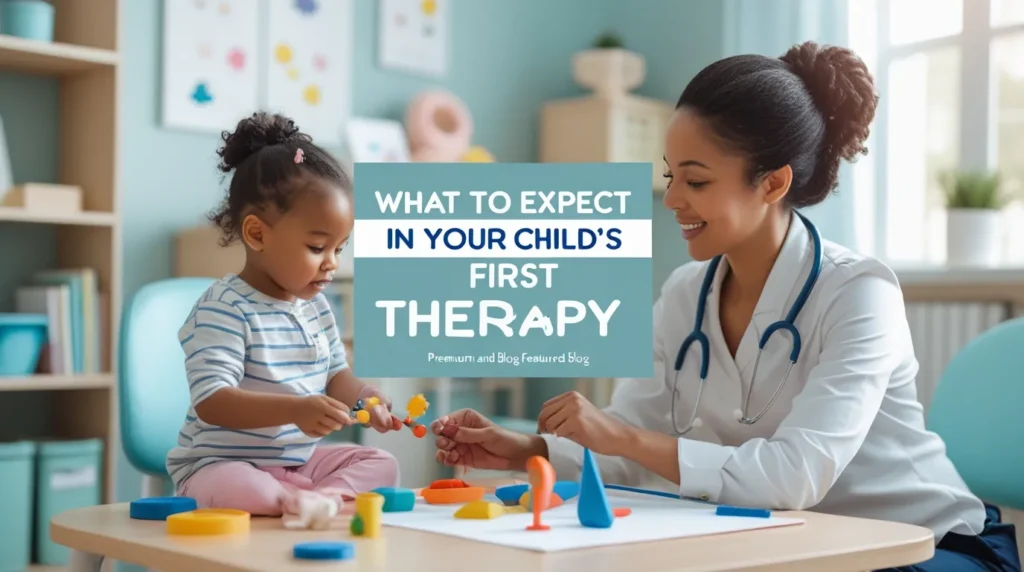
The session usually begins with what therapists call a “warm-up.” The therapist will greet your child at their level — sometimes sitting on the floor, sometimes using a favourite toy or activity to spark curiosity. This phase is all about building rapport, which is a fancy word for simply getting along.
For children who are shy or anxious, this phase might last five or even ten minutes. And that is perfectly okay. A good therapist never rushes a child.
The Activity Phase
Once your child feels at ease, the therapist will gently guide them into structured activities. These activities are carefully chosen based on the type of therapy your child needs.
If your child is in speech therapy, the activities might involve repeating sounds, pointing to pictures, or playing a game that encourages talking. The goal during this first session is not perfection — it’s participation.
If your child is in behaviour therapy, the therapist may introduce simple tasks with clear instructions and immediate, positive feedback. Techniques like positive reinforcement and discrete trial training are commonly used at this stage to help the child understand what is expected and feel rewarded for trying.
If your child is in occupational therapy for kids, expect activities involving fine motor skills — things like stacking blocks, holding a crayon, or sorting coloured objects. The therapist is watching how your child’s hands, fingers, and coordination work in real time.
The Cool-Down and Wrap-Up
Every session ends gently. The therapist will bring the activity to a natural close, praise your child for their effort (not results), and often end with something fun — a sticker, a small toy, or simply a warm goodbye. This helps your child associate therapy with positive experiences, which is critical for the sessions that follow.
How Long Is a Typical First Session?
For most children, the first therapy session lasts between 30 and 45 minutes. This may seem short, but for young children — especially those experiencing therapy for the first time — it is the right length. Longer sessions in the beginning can lead to overstimulation and anxiety, which is the opposite of what we want.
As your child becomes more comfortable and familiar with the therapist and the environment, session lengths may gradually increase based on the therapist’s recommendation and your child’s needs.
What Should You, as a Parent, Expect to Do?
Your role in your child’s therapy journey is bigger than you might think. Here is what typically happens on your end during that first visit:
- You will fill out paperwork. This includes developmental history, family background, and a summary of your concerns. Be as honest and detailed as possible — even the small details matter.
- You may or may not be in the room. Some therapists invite parents to observe; others ask parents to step outside so the child doesn’t become dependent on or distracted by a familiar presence. Either way, the therapist will explain their reasoning.
- You will have a short debrief afterwards. After the session, the therapist will sit down with you and share their initial observations. This is your chance to ask questions — and you should ask as many as you need.
- You will receive guidance on what to do at home. Early intervention therapy works best when the strategies used in the session are also practised at home. The therapist may give you simple, actionable tips to start with right away.
What Are the Signs That Therapy Is Going Well?
Parents often ask: “How will I know if this is actually working?” It’s a fair and important question.
Here are some early signs that your child is responding well to therapy:
- Willingness to go back. If your child doesn’t dread the next session, that’s a great sign.
- Small changes at home. Maybe they’re making more eye contact, trying to say a new word, or following a simple instruction they couldn’t before.
- Better emotional regulation. They may handle frustration a little more calmly than they used to.
- Increased engagement. They might show more curiosity or interest in activities and people around them.
According to the Centers for Disease Control and Prevention (CDC), children who receive early intervention services show measurable improvements in communication, social skills, and adaptive behaviour within the first few months of consistent therapy.
Remember: progress in child development therapy is not always linear. There will be days that feel like a step backward. What matters is the overall trend over weeks and months.
Common Questions Parents Ask Before the First Session
If you’re still feeling uncertain, you’re not alone. Here are the questions we hear most often from parents at SSR — and honest answers to each one.
Is my child too young for therapy?
No. In fact, the earlier therapy begins, the better. Early intervention therapy in Pakistan is recommended for children as young as 18 months if developmental delays are suspected. The younger brain is remarkably adaptable, and therapy at an early age takes advantage of that natural window of growth.
Will my child cry or refuse to cooperate?
It’s possible, and it’s okay. Many children feel uncertain in a new environment. A skilled therapist is trained to handle this with patience and calm. If your child is distressed, the therapist will slow down, comfort them, and try again. One difficult session does not define the outcome.
Do I need a diagnosis before starting therapy?
Not necessarily. Many therapy centres, including SSR, offer assessments that can help identify whether your child needs further evaluation. You do not need a formal autism diagnosis or any other label to begin therapy. What matters is that your child is showing signs of a developmental delay or difficulty, and you want support.
How many sessions will my child need?
This depends entirely on your child’s needs, goals, and rate of progress. Some children show significant improvement within a few weeks. Others may benefit from therapy over several months or even longer. The therapist will discuss a realistic timeline with you after the assessment.
Can behaviour therapy and speech therapy happen at the same time?
Absolutely. In fact, a multidisciplinary approach — combining behaviour therapy, speech therapy, and occupational therapy — is considered one of the most effective strategies for children on the autism spectrum or those with multiple developmental challenges. At SSR, we offer comprehensive therapy programmes designed to work together, not in isolation.
Why Choosing the Right Therapy Centre Matters
Not all therapy centres are created equal. When you’re looking for a therapy center for special children in Islamabad or behaviour therapy in Rawalpindi, the environment, the therapists, and the approach matter enormously.
Here is what to look for:
- Qualified and experienced therapists who specialise in paediatric therapy
- A warm, child-friendly environment that feels safe and inviting — not clinical or intimidating
- A individualised approach — your child’s programme should be built around their unique needs, not a standard template
- Parent involvement — a good centre will actively include you in the process, not shut you out
- Transparent communication — you should always know what is happening in your child’s sessions and why
At Special School of Recovery (SSR), we believe that therapy is not just something that happens inside a room. It is a partnership between the therapist, the parent, and the child. That is why we invest heavily in our speech, behaviour, and occupational therapy services — and in making sure every family feels supported from day one.
A Quick Comparison: What Each Type of Therapy Focuses On
| Therapy Type | Primary Focus | What It Helps With |
|---|---|---|
| Speech Therapy | Communication and language | Speech delay, language development, articulation |
| Behaviour Therapy | Understanding and shaping behaviour | Autism, ADHD, social skills, emotional regulation |
| Occupational Therapy | Daily living skills and motor function | Fine motor skills, sensory processing, independence |
Many children benefit from more than one type of therapy, and combining them is often the most effective path forward.
What the Research and Experts Say
The evidence behind early childhood therapy is strong and growing. The National Health Service (NHS) emphasises that children who receive structured, goal-oriented therapy early in life have significantly better outcomes in school, social settings, and overall wellbeing.
The American Speech-Language-Hearing Association (ASHA) notes that speech therapy is most effective when it begins during the critical window of early childhood — typically before age five — when the brain is still developing rapidly and is most open to learning new patterns.
These aren’t just opinions. They are backed by decades of research and real-world results from thousands of families around the world.
Preparing Your Child for Their First Session: A Simple Checklist
Want to make that first visit as smooth as possible? Here are a few simple things you can do beforehand:
- Talk to your child about it. Keep it simple and positive: “We’re going to meet someone who is going to play with you and help you learn new things.”
- Bring comfort items. A favourite toy, blanket, or stuffed animal can make a big difference for anxious children.
- Make sure they’re well-rested and fed. A tired or hungry child will have a much harder time engaging.
- Arrive a few minutes early. This gives your child time to adjust to the new environment before the session begins.
- Stay calm yourself. Children pick up on their parents’ emotions. If you feel relaxed and positive, your child is more likely to feel the same.
Final Thoughts: You’re Already Doing the Right Thing
If you’ve read this far, you already care deeply about your child’s wellbeing and development. And that matters more than you know.
Taking that first step into a therapy session is one of the bravest and most loving things a parent can do. It doesn’t mean something is “wrong” with your child. It means you are giving them every possible chance to grow, learn, and thrive.
At Special School of Recovery in Islamabad, we are here to make that journey as comfortable, transparent, and effective as possible — for your child, and for you.
📞 Ready to Take the First Step?
Book an assessment today at Special School of Recovery (SSR), Islamabad, and give your child the support they deserve.
📍 Location: Islamabad, Pakistan 🌐 Website: ssr.org.pk 📞 Contact us to schedule your child’s first session — no pressure, no obligation, just a conversation.
Frequently Asked Questions (FAQ)
Q: What happens in a child’s first therapy session? A: The therapist introduces themselves gently, observes your child through play-based activities, and begins building a comfortable relationship. No formal testing or pressure is involved.
Q: How long does the first therapy session last? A: Typically 30 to 45 minutes, depending on the child’s age, attention span, and comfort level.
Q: What age can a child start therapy in Pakistan? A: Children can begin early intervention therapy as young as 18 months if developmental concerns are present. Earlier is generally better.
Q: Do I need a diagnosis before my child can start therapy? A: No. An assessment at the therapy centre can help determine what support your child needs without requiring a prior diagnosis.
Q: Is behaviour therapy safe for young children? A: Yes. Evidence-based behaviour therapy techniques like positive reinforcement are gentle, structured, and designed specifically for children. They are safe and widely recommended by developmental experts.
Q: How do I know if therapy is working for my child? A: Look for small but consistent changes — better engagement, willingness to return to sessions, improved communication, or calmer behaviour. Progress is measured over weeks, not days.
Q: Can speech therapy and behaviour therapy be done together? A: Absolutely. A combined, multidisciplinary approach is often the most effective strategy, especially for children with autism or multiple developmental needs.
Q: Where can I find behaviour therapy for children in Islamabad? A: Special School of Recovery (SSR) in Islamabad offers comprehensive behaviour therapy, speech therapy, and occupational therapy programmes tailored to each child’s unique needs.